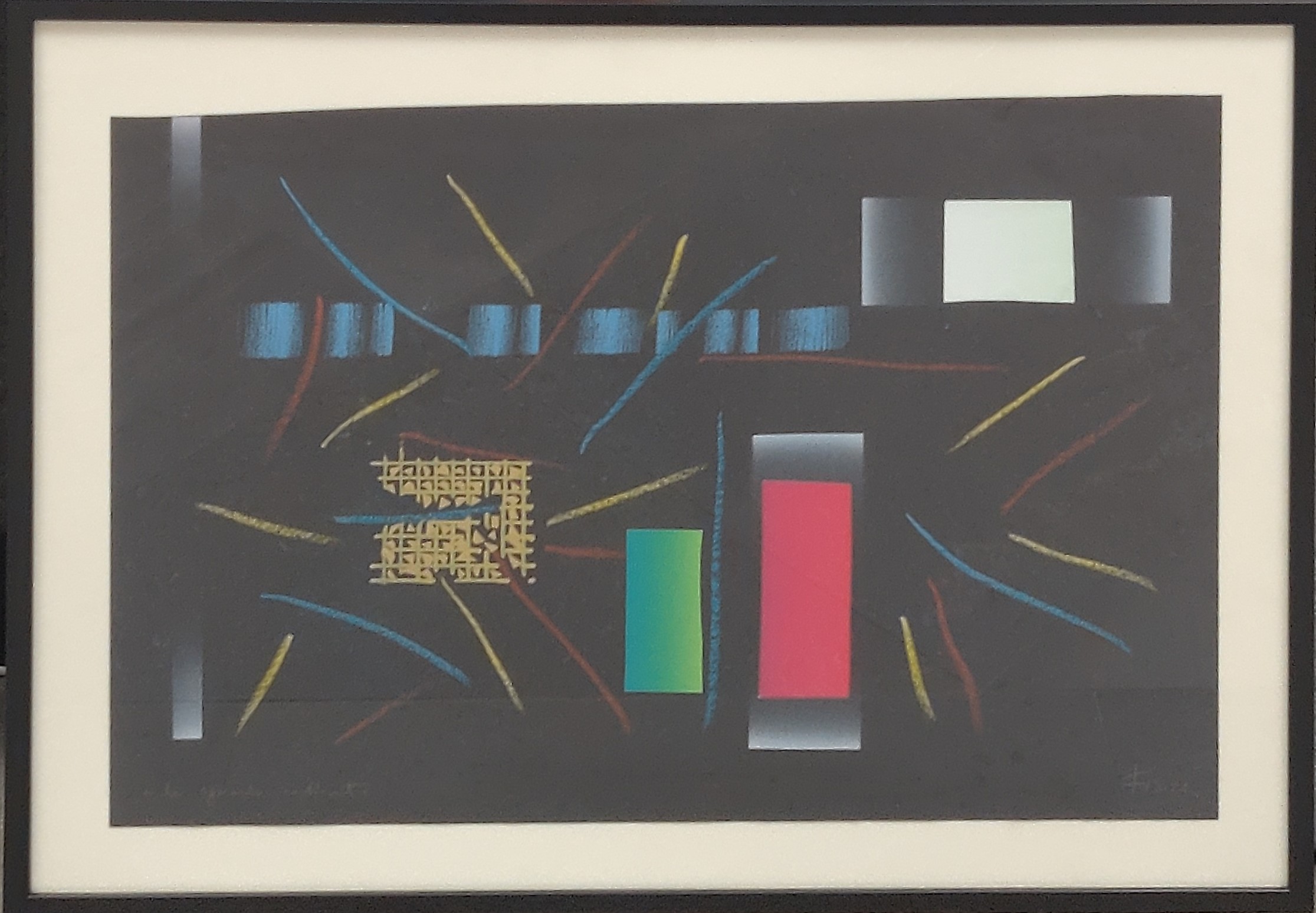
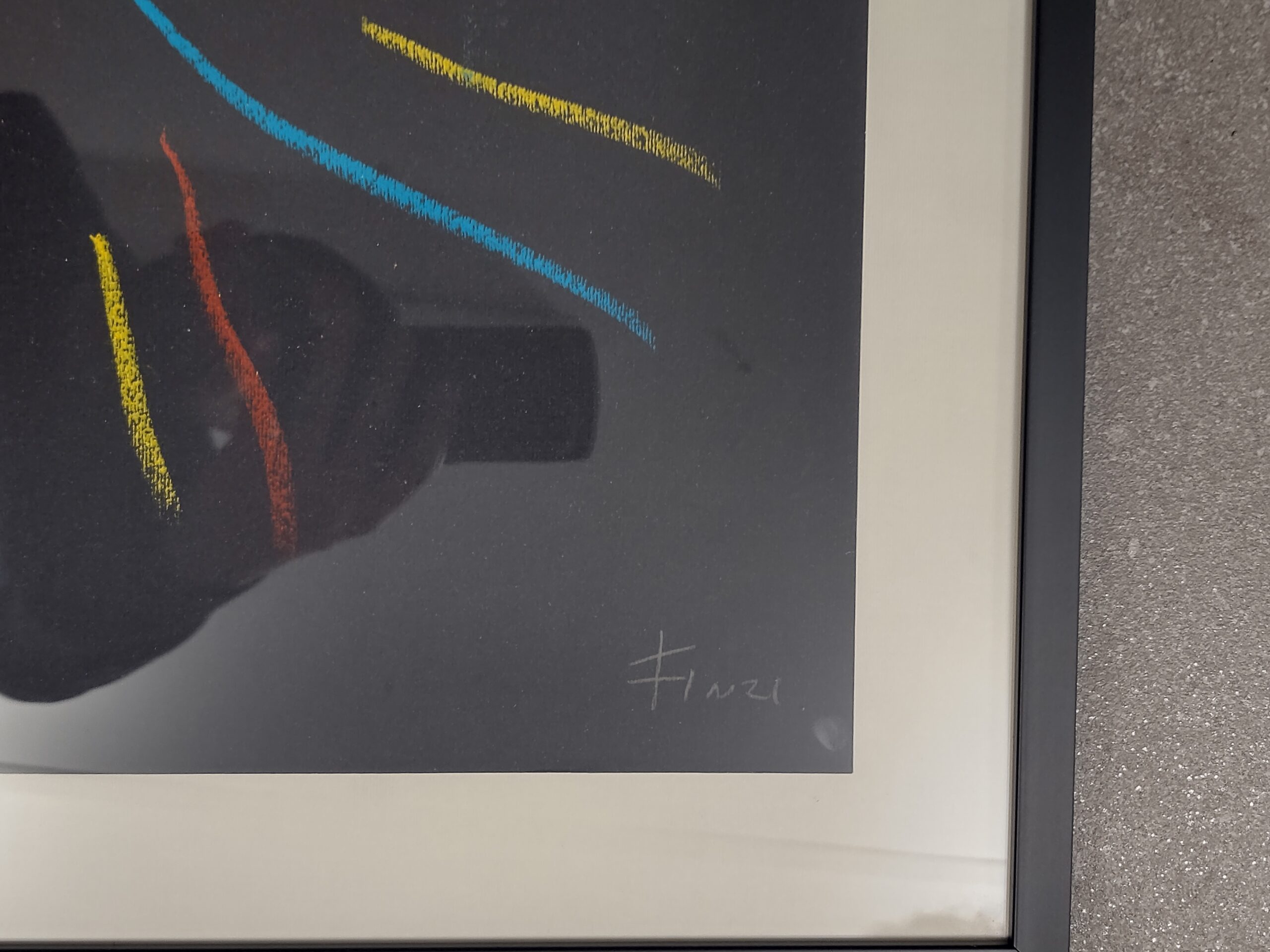
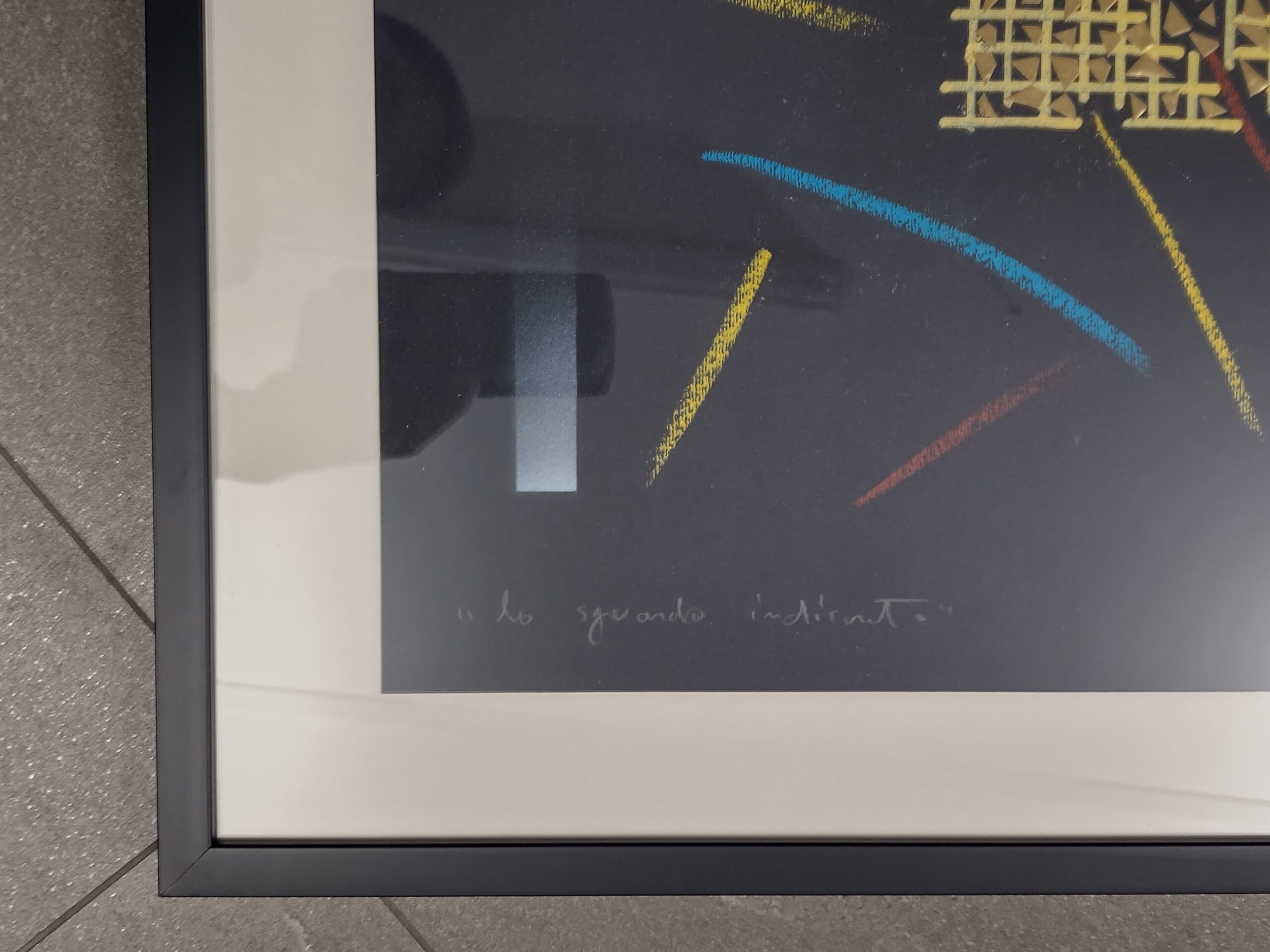
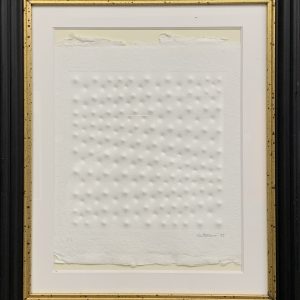
Ennio Finzi was born in Venice in 1931 and, at a very young age, became interested in painting and music. After temporarily attending courses at the Venice Art Institute he was attracted by the fascinating discovery of the structural upheaval of Cubism, which allowed him to transcend the real datum of representation. With the 1948 Biennale, the Historical Archives of Contemporary Arts reopened in Venice, and this fact offered him the opportunity to devote himself to the study of the masters of the historical avant-gardes. The meeting with Atanasio Soldati, generates a stimulus that will influence later works characterized by bright chromatics and rigorous formal balances. Thus were born the first “inventions” in which rhythm, color, light, timbre, take on the role of supporting elements and will become a basic constant of all his research. Considerable influence in those years is exerted on Finzi by Virgilio Guidi for the ideological force of creative thought and by Emilio Vedova for the impetus of the gesture that attacks the surface. The discovery of dodecaphonic music led him to appropriate the principle of “dissonance,” Suddenly, in this way, the praxis of a color freed from any relationship of tone and charged with the exclusive function of timbre, opened up new and vast horizons, so much so that from that moment and until the end of the 1950s his work would result in an obsessive research on the semantics of gesture, light, timbre. The sound-color relationship, a color that Finzi, rather than “seeing,” likes to “listen to” in its most intimate resonances, allows him to express himself according to other entirely aleatory rules in unbounded autonomy. In the late 1950s, marked by the unsettling insights of Lucio Fontana, whom Finzi met in Milan on the occasion of one of his exhibitions at the Apollinaire Gallery, gestural turbulence and expressive urgency subside and a more reflective dimension takes over in the direction of going beyond painting itself, with the approach to gestalt theories on the phenomenology of perception. The principles of optical art inform his research on optical suggestion until 1978.
In 1980 painting regains the dominant space with a subsequent alternation of color and noncolor, light and darkness contending for the surface of the work. Black is posited as the light of darkness, of emptiness, of silence and leads him to probe the most secret resonances of the nonexistent on the invisibility of painting itself. In the continuous dialectic that distinguishes the principle of research, Finzi proceeds by successive stages of evolution characterized by expansions of chromatic sumptuousness and sudden resetting of all luminosity in which he concentrates in the potential state every energetic emission.
He began exhibiting in 1949 at the Bevilacqua La Masa foundation in Venice, where he held his first solo show in 1956.
He participated by invitation in 1959 and 2000 at the Quadriennale in Rome and in 1986 at the XLII Venice Art Biennale.
Noteworthy are, in addition to the 1980 anthological exhibition at the Bevilacqua La Masa in Venice, the exhibition at the Galleria d’Arte Moderna e Contemporanea in Palazzo Forti (Verona) and the one at the Galleria d’Arte Moderna Palazzo dei Diamanti (Ferrara). During 2002 a major retrospective exhibition was held in Rome and Spoleto entitled: Ennio Finzi, Venice and the Postwar Avant-Garde.
The last major solo exhibition was held during 2005 in Urbino in the rooms of the Ducal Palace.
During 2006 and 2007 together with the works of Gino Morandis he exhibited in Prague, at the Manes Foundation, and in Naples in the rooms of the Royal Palace.
He has taught at the Academy of Venice.
He lives and works in Venice-Mestre.